![superfy Logo-Neg-4.png]](https://knowledge.superfy.com/hs-fs/hubfs/superfy%20Logo-Neg-4.png?height=30&name=superfy%20Logo-Neg-4.png)
The density value for Batteries is an estimate based on research from the Scottish Environmental Protection Agency and the Agency for Statistics of Bosnia and Herzegovina.This information helps customers estimate and report batteries waste volumes, aiding waste management planning.
While customers can input their own waste density or weight data, the provided estimate can be used when specific is unavailable. Additionally, the platform allows for the addition of unlimited custom waste types.
The Scottish Environmental Protection Agency and the Agency for Statistics of Bosnia and Herzegovina classify batteries under the EWC code 16 06, 20 01 33 and 20 01 34, which includes lead batteries, Ni-Cd batteries, mercury-containing batteries, alkaline batteries (except 16 06 03), and other batteries and accumulators.
The estimated density values for the aforementioned types of batteries can be found in the report published by the Scottish Environmental Protection Agency, which is available in the agency's Media Library. These estimates are based on a comprehensive review of various sources, including published studies and expert insights from the indstry.
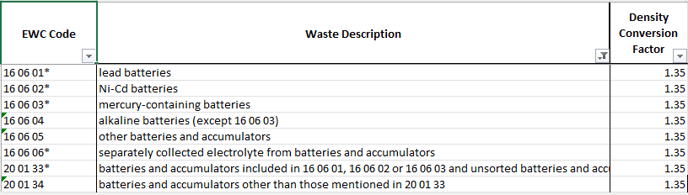
Additionally, the Waste Weight Determination report by the Agency for Statistics of Bosnia and Herzegovina also confirms the minimum density for these batteries to be 1.35t/m3 which converts to 1.35kg/L.
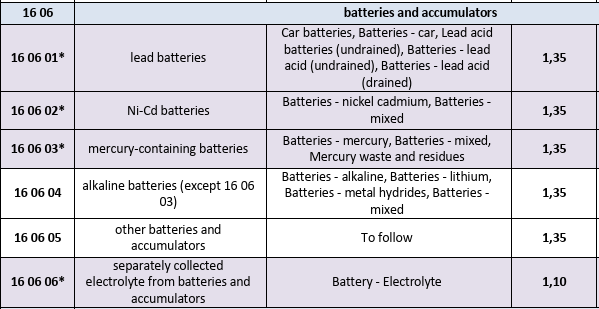
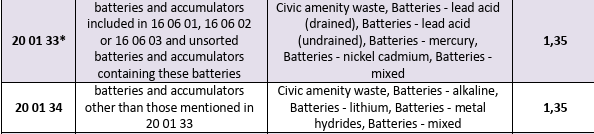
The table below presents the density values for Batteries across the various metrics available on the Superfy platform.

A European Waste Catalogue (EWC) Code is a six-digit code used to identify waste as listed in the European Waste Catalogue. It is formatted as three pairs of numbers, for example 12 34 56. It identifies and classifies waste into categories according to how these wastes have been produced. It adequately describes the waste being transported, handled or treated. It can also be referred as a LoW Code (List of Waste Code).