![superfy Logo-Neg-4.png]](https://knowledge.superfy.com/hs-fs/hubfs/superfy%20Logo-Neg-4.png?height=30&name=superfy%20Logo-Neg-4.png)
The density value for Glass is an estimate taken directly from research documentation provided by the Scottish Environmental Protection Agency (SEPA), Blue Environment, and the University of Northern Iowa. This information is valuable for estimating and reporting general waste weight, particularly in situations where waste measurement tools or data are not accessible.
Additionally, the platform allows for the addition of unlimited custom waste types.
The EWC code 20 01 02 and a report by Blue Environment defines glass waste as whole glass bottles from food and beverage containers including jars, glass containers, mixed glass, glass trays, etc.
The Scottish Environmental Protection Agency (SEPA) report, available in the agency's Media Library, indicates that the density value for glass categorized under the EWC Code 20 01 02 is estimated to be 0.33 kg/L. This figure is based on a comprehensive analysis of various sources, including published research and insights from industry experts.

Another report by the Blue Environment, titled, Australian standard for waste and resource recovery data and reporting also reports that the density value is 0.0.34t/m3 which converts to 0.34kg/L.

Lastly, the Material Weights and Conversions report by the University of Northern Iowa that glass waste weighs between 500-550lbs. To estimate the density, we used the higher value of 550 lbs, which converts to approximately 0.3263 kg/L.
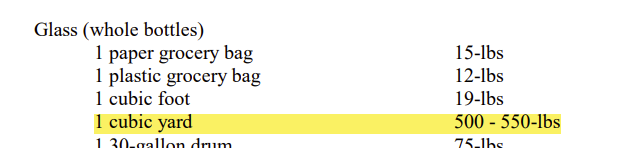
For consistency on the platform, we opted for the 0.33kg/L value reported by the Scottish Environmental Protection Agency (SEPA).
The table below presents the density values for Glass Waste across the various metrics available on the Superfy platform.

A European Waste Catalogue (EWC) Code is a six-digit code used to identify waste as listed in the European Waste Catalogue. It is formatted as three pairs of numbers, for example, 12 34 56. It identifies and classifies waste into categories according to how these wastes have been produced. It adequately describes the waste being transported, handled, or treated. It can also be referred to as a LoW Code (List of Waste Code).