![superfy Logo-Neg-4.png]](https://knowledge.superfy.com/hs-fs/hubfs/superfy%20Logo-Neg-4.png?height=30&name=superfy%20Logo-Neg-4.png)
The Superfy platform includes a set of 10 standardised common waste categories, each accompanied by standardised density values.
The density value for Organic Waste is an estimate based on research from the Irish Environmental Protection Agency (EPA) and the Minnesota Pollution Control Agency. This information aids customers in estimating and Organic Waste volumes, facilitating effective waste management planning.
While customers can input their own waste density, the provided estimate can be used when data is unavailable. Additionally, the platform allows for the addition of unlimited custom waste types.
According to the Irish Environmental Protection Agency, and the Minnesota Pollution Control Agency, organic waste is described as food waste, green/garden waste and compostable products.
The table below, extracted from a report published by the Irish Environmental Protection Agency titled National Waste Statistics: Guidance for Estimating Quantity of Waste Generated On-Site, outlines the typical weights of Organic Waste when the bins are full, categorized by different bin sizes.

To calculate the density for Organic Waste, we utilised the density formula detailed below. This method considers all bin sizes and weights highlighted in the above table, enabling us to derive an average density for this waste type.

Density 140L: 38/140 = 0.271
Density 240L: 100/240 = 0.417
Average Density: 0.271+0.417 = 0.688/2 ≈ 0.34kg/L
According to the Volume-to-Weight Conversions report by the Minnesota Pollution Control Agency the average density for source separated organic material (SSOM) drop-site collection is 556.8lbs/cy, which converts to 0.3303kg/L. To ensure consistency across the platform, we have chosen to adopt the average density of 0.34 kg/L derived from the data provided by the Irish Environmental Protection Agency.
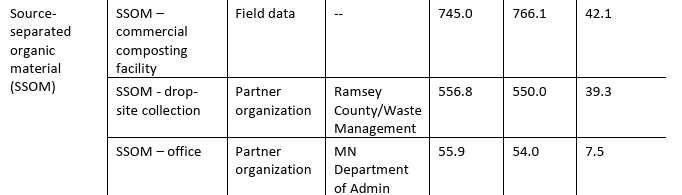
Source-separated organic material (SSOM) includes wasted food, food scraps,
certified compostable food packaging, and non-recyclable (unlined) paper (such as paper towels and napkins).
The table below presents the density values for Organic Waste across the various metrics available on the Superfy platform.

An European Waste Catalogue (EWC) Code is a six-digit code used to identify waste as listed in the European Waste Catalogue. It is formatted as three pairs of numbers, for example 12 34 56. It identifies and classifies waste into categories according to how these wastes have been produced. It adequately describes the waste being transported, handled or treated. It can also be referred as a LoW Code (List of Waste Code).
European Waste Catalogue (EWC) Code 20 01 08 refers to biodegradable kitchen and canteen waste and is classed as a Absolute Non-hazardous code.